The limit
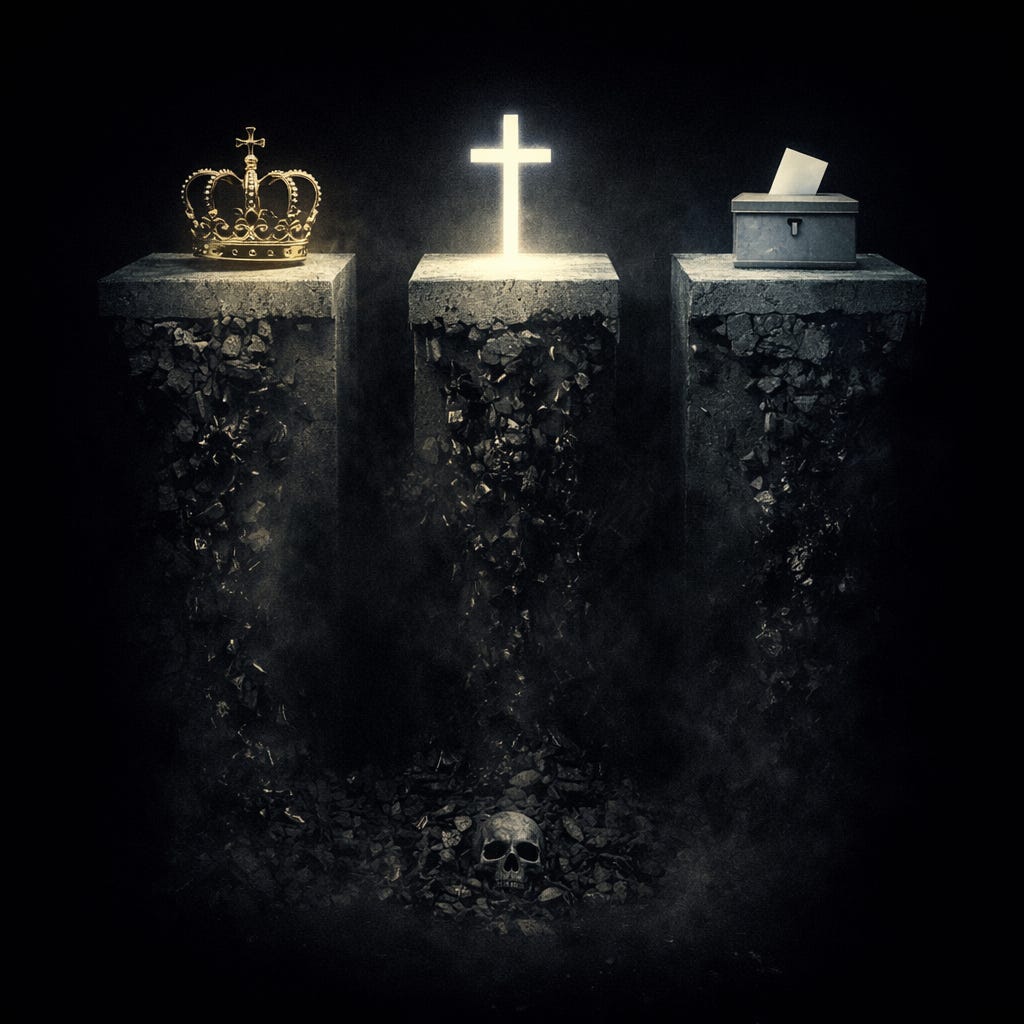
Monarchy, theocracy, democracy. Everything changes. Who rules, how they're chosen, what they declare. But one thing never changes: none of these systems can end on their own. They have no halting condition. They cannot fail.
A monarchy does not foresee its own extinction. It carries on by hereditary inertia until someone tears it down. A theocracy does not contemplate doubt. It justifies itself through the sacred, and the sacred does not expire. And democracy? Democracy is the most insidious of the three, because it presents itself as the best possible system and with that premise makes itself untouchable. It must exist. Always. No matter what. Even when it doesn't work, even when it produces wars, even when a vote is worth less than the money that buys it.
The flaw was never which government. The flaw is that no government can die.
And a system that cannot die has no reason to work well.
The Principle
A system of government must contain the possibility of its own failure. Not as catastrophe, not as revolution. As an internal mechanism. If it cannot convince its participants to sustain it, it ends. This possibility is what keeps it alive.
This is no different from anything else that works. A company that produces no value closes. An organism that does not adapt dies. Only States are exempt from this rule, and the result is plain to see.
The Mechanism
The voting power of every citizen is proportional to the percentage of taxes they voluntarily choose to pay on their labor income.
I pay 5%, my vote weighs 0.05. I pay 30%, it weighs 0.30. I pay nothing, I don't vote. Not because someone forbids it. Because I chose not to participate.
Only labor is taxed. Not wealth, not inheritance, not financial returns. Only labor. Because labor is the only transaction that needs no oversight: someone pays, someone receives, the State is the third witness. Three parties, no ambiguity.
Financial returns? Taxed separately. And who sets the rate? The politics of labor. The people who work every day decide how much speculation weighs. Those who work have no interest in subsidizing those who don't.
One rule. Everything else follows.
What Follows
The black market becomes useless. You can get rich outside the taxed circuit all you want. But that money buys you no power, no representation. In a State governed by those who work, the black market isn't cleverness. It's self-exclusion.
Bureaucracy collapses. Not through reform but through absence of necessity. If you only tax labor and labor is self-certifying, 90% of current controls have no reason to exist. Tax codes, income brackets, fiscal regimes, deductions, exemptions. All gone. Down to the bone.
Lobbying changes nature. You can no longer buy consensus through volume. Influence becomes technical: where to push the State on industrial, technological, agricultural policy. Those who work know what they need to work better.
Borders gain meaning. They no longer separate ideologies or invented identities. They separate labor systems. The border becomes the perimeter within which your contribution has effect. You no longer endure it. You choose it.
And it's the percentage that matters, not the amount. A worker at 20% weighs the same as an executive at 20%. A doctor earning 800,000 euros through work who chooses 25% has more voice. That money was earned treating people. If it was deserved, it's better that voice is heard.
The State Must Be Earned
Here is the point that changes everything: does this system have enough money? The answer is that it doesn't matter. The State does not have a fixed cost that citizens must meet. The State costs what citizens decide they can afford. If you want a large State, you pay more. If you want a minimal State, you pay less. The State adapts to you, not you to it.
And if nobody pays enough? The State contracts. And if it is not capable of being useful enough, it dies. Not through revolution. Through irrelevance.
This is the limit. This is what no system of government has ever had.
Taxes stop being an extraction and become the very reason for the State. You pay because you want it to work. You pay because your labor needs a context that works. It's volunteering. The reason the concept of the State was born in the first place.
Those Who No Longer Vote
Retirees don't vote. Those who have finished working have finished deciding. They had their voice for decades. Now they listen.
It's brutal. It's consistent. And it solves a problem no current democracy knows how to solve: an aging population that votes to conserve and blocks the future of those who work. In this system, those who work decide. Those who have worked have already decided.
Who Invades You
Nobody. You invade me? What do you find? There is no throne to occupy, no apparatus to capture, no treasury to seize. Power is not in a building. It's in the distributed labor of millions of people who stop paying your regime the day after the invasion. You control nothing.
The only option is to start working with us. Welcome.
When the State Dies
What if it collapses? What if the breathing stops? No trauma. Smaller and more efficient aggregations form, or larger ones. Those who work reorganize around those they want to work with. No civil wars, no revolutions. Just natural reorganization. As it has always been, but without the blood.
Those Who Cannot Work
And those who can't? Those who are ill, disabled, those whom life has placed outside the productive circuit not by choice but by condition?
Their vote is worth 100%.
This is not compassion. It's structure. They are few, they don't compete economically, they don't accumulate power. But they see the system entirely from outside its productive mechanism. They see what labor produces without being inside it. They are the system's observation function on itself. The human thermometer.
And they naturally tend to ask for protection, care, services. They function as a counterweight to a purely economic system. Without them the system is a machine. With them, it breathes.
The Parliament
Two wings. On one side, those who produce and pay. On the other, those who cannot work and observe. What can they do? One thing only: adjust the tax knobs. Raise, lower, redistribute. That's it. Nothing else is needed.
No need for thousands of laws. No committees, subcommittees, regulations, amendments. Two groups turning the same knob in opposite directions until they find balance.
And the government? The government must spend. Well. Extremely well. Because if it spends badly, everything collapses for real. Not figuratively. The State collapses. Politics stops being ideology and becomes engineering. Those who govern don't promise. They build. Or they fall.
Ethics and Morality
And all the ethics, morality, prohibitions, religious taboos, cultural restrictions? Outside the system. Separate. And measurable.
You don't eat pork? Don't consume it. That's it. Your choice exists as an economic choice. Less consumption, fewer transactions, less tax, less representation. No street protests, no impositions, no culture wars. Just individual choices with individual consequences.
Only ideologies that produce something survive. The useless ones die on their own. No need to fight them.
Justice
It doesn't exist. It's not needed.
Alone, you do whatever you want. Always. Individual freedom is total. But labor is impossible alone. Exchange requires at least three parties and deserves respect. Every transaction is already supervised by structure. Those who disturb the system exclude themselves. Those who steal, cheat, destroy, lose access to the circuit that generates power. No judge is needed. The system judges.
Injustices are inefficiencies. And inefficiencies, in a system that can die, get eliminated. Not out of cruelty. Out of survival. Perfect justice is one that needs no judges because everyone is one.
Finance
Finance naturally splits in two. On one side, investment: money that enters labor, that funds those who produce, that generates taxable transactions. On the other, gambling: pure speculation, bets on numbers, money generating money without passing through labor.
There is no reason for them to remain mixed. In the current system they are, because it benefits those who speculate. In this system, those who work decide how much gambling weighs. And those who work have no reason to protect it.
The World That Emerges
Probably small States, hyper-connected. When a State is small it fuses with its territorial resources. Those who work that land, that sea, that resource, command.
Seychelles, 2053. The Seychellois fish and farm. They tax themselves at 50% to keep a State alive. A billionaire arrives, works remotely, settles in. Does he want to pay 50% without having any real say? No. The fishermen and farmers command. The land belongs to those who work it. Not to those who park their yacht there.
It's the total inversion of the tax haven. Paradise is not where you pay less. It's where you work the most and decide the most.
The Real Change
Sociopolitical change has never been about the type of government. It's about the possibility of failure. That is what makes us work, what keeps us honest, what makes anything alive.
Remove from a system the possibility of death and you will have a dead system that doesn't know it.
Current democracy is exactly this. An immortal system. Therefore dead.
What I propose is a mortal system. Therefore alive.